

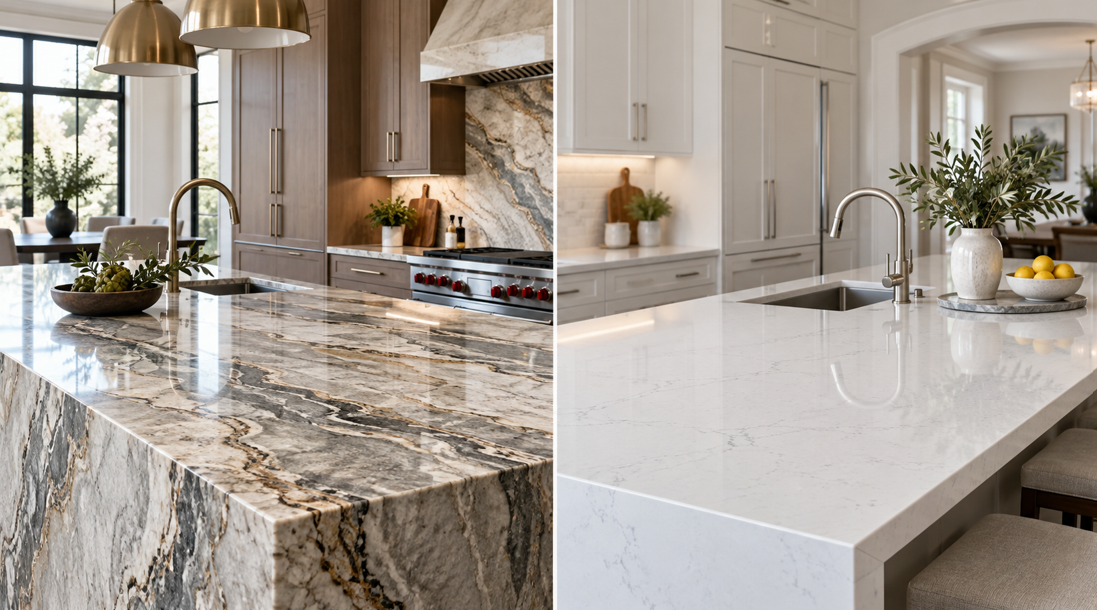
Quartz and quartzite sound almost identical, and both can create elegant, enduring kitchen countertops. Yet they are fundamentally different materials — and choosing between them can influence everything from the character of your kitchen to the amount of day-to-day maintenance your surfaces require.
Quartzite is natural stone formed through geological processes and quarried in slabs, so every piece carries its own colour, movement and veining. Quartz countertops are engineered surfaces created using quartz or mineral content combined with binders and pigments, giving manufacturers greater control over pattern, colour and consistency.
For Teaneck homeowners, the better choice depends less on which material is “best” and more on the experience you want from your kitchen.
At Dash Cabinetry, we help homeowners consider the complete design — cabinetry, countertops, lighting, hardware and everyday functionality together. If you are deciding between quartzite and quartz for a Teaneck kitchen renovation, understanding how the two materials differ is the best place to begin.
Quartzite vs. Quartz: The Quick Answer
Both materials can be excellent choices, but they suit different priorities.
Consideration | Quartzite | Quartz |
|---|---|---|
Material | Natural quarried stone | Engineered surface |
Appearance | Unique natural variation | Controlled, repeatable patterns |
Maintenance | May require sealing depending on the stone | Generally does not require sealing |
Stain resistance | Good with appropriate care and sealing when recommended | Highly stain resistant and nonporous |
Heat | Natural stone generally tolerates heat well; trivets are still recommended | Hot cookware should be placed on trivets |
Pattern consistency | Every slab is different | More predictable from sample to installation |
Design character | Organic, luxurious and one-of-a-kind | Refined, versatile and controlled |
Best suited to | Homeowners who value natural stone and individuality | Homeowners prioritising easy maintenance and consistency |
The simplest way to think about the decision is this:
Choose quartzite when natural variation and one-of-a-kind stone character are central to your design. Choose quartz when consistency, low maintenance and predictable performance matter most.
For many Teaneck kitchens, either material can work beautifully. The surrounding cabinetry, household routine and preferred aesthetic help determine which one feels more natural in the space.
What Is Quartzite?
Quartzite is a natural metamorphic rock. It begins as sandstone and changes under intense heat and pressure, producing a dense stone with a high quartz content.
For kitchen design, its greatest attraction is visual authenticity.
No two natural quartzite slabs are exactly alike. Colour transitions, veins, mineral markings and subtle variations develop naturally rather than being printed or deliberately repeated. That individuality can make a quartzite island or perimeter countertop feel less like a manufactured surface and more like an architectural feature.
Some varieties are quiet and understated, with creamy backgrounds and delicate movement. Others are dramatically expressive, combining sweeping veins, deep contrasts and unexpected colour.
This gives homeowners considerable creative flexibility.
A warm quartzite with beige and taupe movement can complement white oak or walnut cabinetry beautifully. A brighter slab with strong grey veining can bring drama to a painted kitchen. More expressive varieties can become the focal point of the entire room, particularly when carried across a large island.
Quartzite also lends itself naturally to the growing preference for warm, organic kitchens. Wood cabinetry, stone, textured finishes and softer neutral palettes all work exceptionally well with genuine natural variation.
The important consideration is that natural stone cannot be controlled in quite the same way as an engineered product.
The sample you initially see provides guidance, but the actual slab deserves careful viewing before fabrication. Veining may change from one area to another, and natural characteristics are part of the material rather than imperfections to be eliminated.
For homeowners who value individuality, that is precisely the appeal.
What Is Quartz?
Quartz countertops are engineered rather than quarried as finished slabs.
Manufacturers combine mineral or quartz content with binders, pigments and other components to create a dense surface with deliberately controlled appearance and performance.
That manufacturing process gives quartz one of its greatest advantages: consistency.
A homeowner can select a particular colour or pattern and have a clearer expectation of how the installed countertop will look across the kitchen. Depending on the design, quartz can be nearly solid in colour, softly patterned or dramatically veined to evoke natural stone.
Modern quartz designs have become particularly sophisticated. Many now use layered movement, warmer backgrounds and more organic-looking veins rather than the uniform speckled patterns associated with earlier generations of engineered stone.
That makes quartz highly versatile.
It can complement traditional Shaker cabinetry, contemporary flat-panel doors, warm natural woods or painted cabinets. It can sit quietly in the background or become a prominent design element.
Quartz is also nonporous and generally does not require sealing, making it attractive to households that want a refined surface with straightforward everyday care.
For a busy Teaneck kitchen where cooking, gatherings and everyday family life all centre around the same space, that convenience can be meaningful.
Which Looks More Luxurious: Quartzite or Quartz?
Luxury is not limited to a single material, but quartzite and quartz create luxury in different ways.
Quartzite feels luxurious because it is inherently unique.
When you select a natural slab, you are selecting a surface that cannot be reproduced exactly. The veins, tones and mineral characteristics belong to that particular piece of stone. On a large kitchen island, the result can be extraordinary.
Quartz creates a more controlled form of refinement.
Instead of accepting nature's variation, homeowners can select a highly specific colour and pattern. This can be particularly useful when the countertop needs to coordinate closely with cabinetry, flooring and adjoining rooms.
Consider a warm white kitchen with natural oak accents.
A quartzite slab with flowing beige and gold movement could bring an organic, one-of-a-kind focal point to the island. Alternatively, a warm white quartz with restrained veining could maintain a quieter, more tailored atmosphere throughout the room.
Neither approach is inherently more sophisticated.
The question is whether you prefer natural individuality or designed consistency.
Quartzite Has the Edge for Natural Variation
For homeowners who want their countertop to look unmistakably natural, quartzite has a clear advantage.
Veins do not follow an engineered repeat. Colour can shift gradually across a slab. Small mineral features and variations create depth that becomes more apparent as light changes throughout the day.
This character makes slab selection especially important.
Rather than choosing solely from a small sample, homeowners considering quartzite benefit from seeing the full slab. A section that appears subtle from one angle may contain dramatic movement elsewhere.
The position of those veins can then become part of the kitchen design.
On an island, fabricators can consider which portion of the slab will be most visible. With a waterfall edge, careful planning can help the pattern continue naturally down the side. When a backsplash uses the same stone as the countertop, slab layout can determine whether the finished installation feels calm or dramatic.
That level of material planning is one reason natural stone can make a kitchen feel exceptionally bespoke.
Quartz Offers Greater Colour and Pattern Control
Quartz takes the opposite approach, and that can be equally valuable.
Because the surface is engineered, colour and pattern are more predictable. If the goal is a warm creamy countertop with restrained taupe veining, homeowners can choose a design created specifically around that appearance.
This becomes especially useful in kitchens with several strong elements.
If the cabinetry features prominent wood grain, bold hardware and statement lighting, a highly dramatic natural stone may compete for attention. A more controlled quartz surface can allow those elements to lead.
Quartz can also make multi-surface projects easier to coordinate.
A large Teaneck kitchen might use the same material on perimeter counters, an island, a beverage station and a nearby serving area. Greater consistency can help those spaces feel deliberately connected.
Homeowners exploring countertops therefore benefit from considering the entire room rather than viewing the surface by itself. Cabinet colour, natural light, flooring and backsplash material can all change how a countertop appears.
Which Is Easier to Maintain?
For homeowners prioritising minimal routine maintenance, quartz generally has the advantage.
Engineered quartz surfaces are nonporous, meaning they do not normally require periodic sealing. Everyday cleaning is typically straightforward with mild soap, water and a soft cloth, following the care instructions supplied by the manufacturer.
Quartzite requires a more individual approach because it is natural stone.
Depending on the specific stone and its characteristics, a fabricator or stone supplier may recommend applying an impregnating sealer to improve resistance to moisture and staining.
A sealer does not make natural stone completely stain-proof. It helps make the surface more resistant while giving homeowners additional time to clean spills.
Natural stone also benefits from appropriate cleaning products. Harsh or unsuitable chemicals can affect certain minerals or surface treatments, so neutral cleaners designed for stone are generally the safer approach.
For a homeowner who wants the simplest possible care routine, quartz is often attractive.
For someone who loves the natural character of quartzite, the additional care is usually a reasonable exchange for having genuine stone.
Which Is Better Around Heat?
Quartzite's natural-stone composition gives it an advantage when heat is an important consideration, but good countertop care still matters.
Natural stone can tolerate substantial heat; however, professional stone-care guidance still recommends using trivets or mats beneath hot cookware. Sudden temperature changes can affect surfaces and nearby seams, adhesives or other components even when the stone itself is highly heat tolerant.
Quartz deserves greater caution around direct heat.
Because engineered quartz contains binders in addition to mineral content, manufacturers commonly recommend placing hot pans, countertop cooking appliances and other heat-producing items on trivets or heat-resistant pads.
In practical terms, neither countertop benefits from treating it as a permanent landing area for extremely hot cookware.
If your household cooks frequently and heavy pots regularly move directly from the range or oven to nearby counters, discussing workflow during kitchen planning can be particularly useful. A thoughtfully positioned range, landing space and protective accessories can make the countertop material less vulnerable regardless of which option you choose.
Which Material Handles Everyday Family Life Better?
Both can perform exceptionally well when properly fabricated, installed and cared for.
Quartzite is known for strength, density and hardness, making appropriate varieties highly suitable for countertop applications. Quartz is also designed to deliver strong everyday durability.
Neither material is indestructible.
Heavy impact can damage edges, especially near sinks, dishwashers and other cut-outs. Cutting directly on the surface is also unnecessary when a cutting board provides simple protection for both the countertop and kitchen knives.
For family kitchens, the maintenance difference usually matters more than a theoretical durability contest.
Quartz gives homeowners nonporous performance with no routine sealing requirement.
Quartzite offers the enduring character of natural stone, with care requirements that depend more heavily on the individual slab.
Think about how your household actually uses the kitchen.
A highly active family that wants to minimise maintenance may appreciate quartz. A homeowner willing to give natural stone appropriate care in exchange for its visual depth may find quartzite more rewarding.
How Quartzite and Quartz Pair With Cabinet Colours
Countertop selection becomes much easier when it is considered alongside cabinetry.
With White Oak Cabinets
White oak has warmth, grain and movement of its own.
A warm quartzite can create a richly organic composition, particularly when its beige, cream or muted gold tones echo the cabinetry.
Quartz can create a calmer pairing. A restrained off-white or warm neutral design allows the wood to become the star while maintaining a sophisticated overall palette.
With White or Cream Cabinets
Both surfaces offer enormous flexibility.
Quartzite can add natural drama and prevent a light kitchen from feeling flat. Quartz can produce a more seamless, airy appearance when its base colour sits close to the cabinetry.
With Dark Blue or Green Cabinetry
Light quartzite creates striking contrast and can introduce natural movement.
Quartz allows the designer to control that contrast more precisely, which is helpful when the cabinetry colour itself is already strong.
With Walnut Cabinets
Walnut benefits from carefully selected surfaces because of its rich colour and expressive grain.
Soft, warm quartz can keep the overall composition balanced. A quieter quartzite can create a luxurious natural-on-natural pairing.
The most successful combination is not necessarily the one with the most dramatic individual samples. It is the one where cabinetry and countertops strengthen each other.
Which Is Better for a Statement Kitchen Island?
If the island is intended to become the visual centrepiece of the room, quartzite is exceptionally compelling.
Large slabs allow natural veining to be appreciated at full scale. The island can become almost sculptural, particularly with carefully planned edge details or a waterfall application.
Quartz can deliver a statement too, especially as engineered patterns become increasingly expressive.
The advantage is predictability. If homeowners want dramatic veining positioned throughout several surfaces with greater consistency, quartz can make the overall effect easier to coordinate.
Another possibility is mixing countertop materials.
A statement quartzite island paired with quieter perimeter surfaces can make the natural stone the focal point while keeping the rest of the room restrained.
Conversely, consistent quartz throughout the kitchen can create a calmer, more architectural appearance.
The choice depends on whether the island is intended to command attention or integrate quietly into the wider composition.
What About Cost?
There is no single price that accurately represents either category.
Countertop cost depends on the specific material or design, slab availability, thickness, fabrication requirements, edge treatment, sink and cooktop cut-outs, backsplash details and installation complexity.
Premium quartzite can carry a significant material cost, particularly when the slab is rare, visually dramatic or difficult to fabricate.
Quartz also spans a wide range of price points. More elaborate patterns, premium collections and specialised fabrication can increase the final investment considerably.
This is why comparing two countertops simply by material name can be misleading.
A particular quartz may cost more than some natural stones, while a rare quartzite may sit well above many engineered options.
For an accurate comparison, it is better to select the actual surfaces you are considering and evaluate the complete installed project.
Quartzite or Quartz: Which Is Better for Your Teaneck Kitchen?
The right answer depends on what you value most.
Quartzite may be the stronger fit if you:
Want genuine natural stone.
Value a one-of-a-kind slab.
Love organic veining and variation.
Want the countertop to become a major design feature.
Are comfortable following natural-stone care recommendations.
Prefer the character that develops from authentic materials.
Quartz may be the stronger fit if you:
Prioritise straightforward everyday maintenance.
Want a nonporous surface that does not require sealing.
Prefer more predictable colour and pattern.
Need several countertop areas to coordinate closely.
Want a broad range of controlled design options.
Prefer a refined surface with fewer natural variations.
For many Teaneck homeowners, there is no wrong choice between well-selected quartzite and high-quality quartz.
The better material is the one that supports the way your household lives while completing the visual story of your kitchen.
See the Materials Together Before Making Your Decision
A countertop is never viewed in isolation once the kitchen is finished.
Its colour changes beside cabinetry. Veins become more or less prominent depending on the backsplash. Natural and artificial light alter warm and cool undertones. Hardware introduces another finish, while flooring connects the kitchen to the rest of the home.
That is why selecting a countertop alongside the rest of the kitchen palette is so valuable.
Quartzite gives Teaneck homeowners something genuinely individual: natural stone with movement, depth and character unique to the slab.
Quartz provides a different advantage: exceptional design versatility, consistent appearance and straightforward everyday care.
At Dash Cabinetry, we help bring those decisions together through personalised design guidance, countertop selection, cabinetry planning, 3D renditions and professional installation. Instead of asking whether quartzite or quartz is universally better, we can help determine which material is better suited to your kitchen, lifestyle and design vision.
If you are planning a kitchen renovation in Teaneck, NJ, or elsewhere in the tri-state area, schedule a consultation to compare countertop options and begin creating a kitchen where beauty and everyday function work effortlessly together.

