

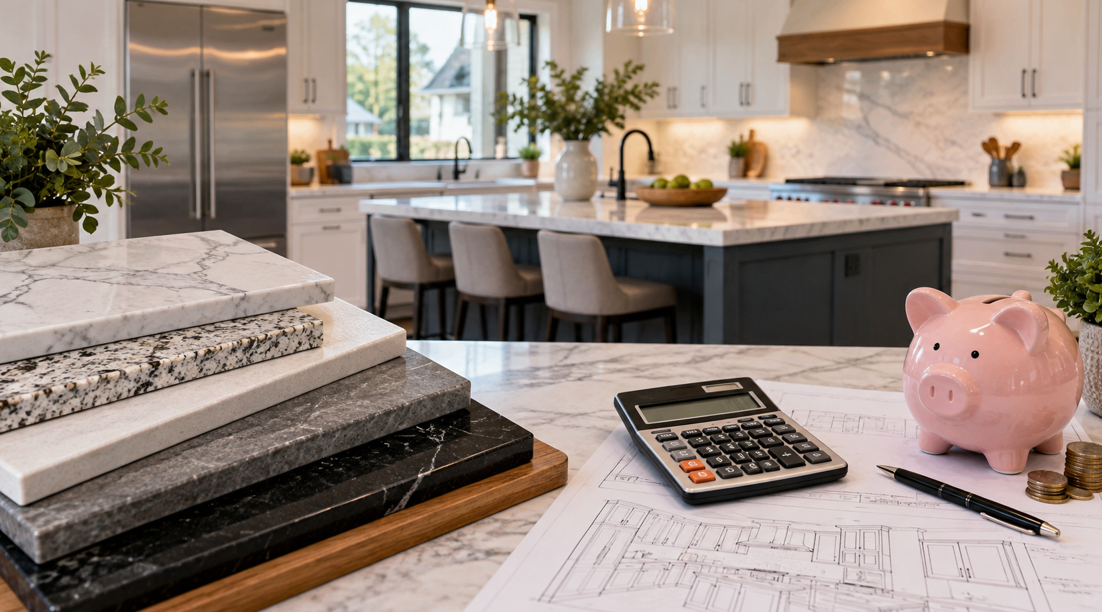
For most Lakewood homeowners planning a kitchen renovation, countertop cost comes down to one practical question: how much should I realistically budget in 2026?
A useful starting point is approximately $50 to $200 per square foot installed for many popular stone and engineered countertop choices, although particular materials can fall below or rise above that range. For a kitchen with around 30 to 40 square feet of countertop space, this can translate into several thousand dollars before additional features such as elaborate edge profiles, full-height backsplashes or unusually complex fabrication are included.
Material is only part of the equation. Slab quality, kitchen size, seams, sink and cooktop cut-outs, edge treatment, removal of existing counters and installation requirements can all affect the final investment.
At Dash Cabinetry, we help homeowners consider the countertop as part of the complete kitchen rather than as an isolated purchase. For Lakewood homeowners planning a 2026 renovation, this guide explains the major cost ranges, what drives those costs and where spending more can make a meaningful difference.
What Do Kitchen Countertops Cost in 2026?
There is no single countertop price that applies to every kitchen, but current installed-cost benchmarks provide a useful planning framework.
Countertop Material | Typical 2026 Installed Planning Range |
|---|---|
Laminate | $20–$80 per sq. ft. |
Solid surface | $50–$150 per sq. ft. |
Granite | $40–$150+ per sq. ft. |
Quartz | $50–$200 per sq. ft. |
Quartzite | $65–$200 per sq. ft. |
Marble | $40–$150+ per sq. ft. |
Butcher block | $50–$150 per sq. ft. |
These figures are broad planning ranges, not fixed Lakewood prices. Individual slabs, brands, fabrication requirements and installer pricing can move a project significantly in either direction.
A 35-square-foot countertop installation, for example, could therefore range from roughly $1,750 for an accessible surface at $50 per square foot to $7,000 for a premium option at $200 per square foot.
Larger kitchens naturally increase the total.
A kitchen with a substantial island, perimeter cabinetry, beverage station and secondary serving area could easily require 50, 60 or more square feet of countertop material.
That is why the square-foot price is useful but never tells the entire story.
For an accurate project budget, homeowners need to consider material + fabrication + edge details + cut-outs + installation + removal or preparation work together.
Quartz Countertops: Approximately $50 to $200 Per Square Foot Installed
Quartz remains one of the most practical choices for homeowners who want a refined appearance with relatively straightforward maintenance.
Current industry cost data places installed quartz broadly around $50 to $200 per square foot, depending on the product, design, thickness and fabrication requirements.
That wide range reflects the enormous variety within the category.
A simpler quartz design with restrained patterning may sit towards the more accessible end of the range. Premium collections with dramatic marble-inspired veining, specialised colours or complex fabrication can move considerably higher.
Quartz can be particularly appealing in a busy Lakewood family kitchen because it offers a nonporous surface and does not normally require sealing.
It also gives homeowners greater visual predictability than natural stone. The pattern seen in a sample or showroom display is generally more representative of the finished installation than a small sample of a highly varied natural slab.
For budgeting purposes, a 35-square-foot kitchen at:
$60 per sq. ft. = approximately $2,100
$100 per sq. ft. = approximately $3,500
$150 per sq. ft. = approximately $5,250
$200 per sq. ft. = approximately $7,000
Those figures illustrate how significantly the selected quartz design can influence the total project cost.
Quartzite Countertops: Approximately $65 to $200 Per Square Foot Installed
Quartzite is a natural stone and one of the strongest choices for homeowners who want genuine geological variation, dramatic veining and a distinctive high-end appearance.
Current 2026 cost references generally put installed quartzite around $65 to $200 per square foot, with premium or rare slabs potentially reaching beyond typical ranges.
Why the variation?
Quartzite is not one uniform product.
One slab may have a quieter cream or grey appearance, while another may feature exceptional movement, unusual colour or dramatic veining. Rarity and visual character can have a substantial effect on the material price.
Fabrication also matters.
A quartzite slab selected for a large island may require careful vein placement. Waterfall edges, mitred details or a full-height matching backsplash may require additional stone and more labour-intensive fabrication.
For many homeowners, however, that individuality is precisely the attraction.
A quartzite island is not simply a work surface. It can become the artistic centrepiece of the room.
If your Lakewood kitchen design calls for a striking natural focal point, it can make sense to direct more of the countertop budget towards the island while taking a quieter approach elsewhere.
Granite Countertops: Approximately $40 to $150 or More Per Square Foot Installed
Granite remains an enduring kitchen material because it combines genuine natural-stone character with durability and a remarkably broad selection of colours and patterns.
Current market guides place granite across a wide installed range, commonly from about $40 to $150 per square foot, depending on grade, source, colour and fabrication.
The range is important because the word “granite” alone tells you very little about price.
More widely available slabs can represent strong value for homeowners who want natural stone without moving immediately into rare premium materials. More distinctive granite with unusual movement, colour or limited availability can cost substantially more.
Like quartzite, granite is selected as a natural slab.
That means viewing the actual material can be an important part of the process. A small sample may not reveal all the variations that will appear across an island or long countertop run.
Granite may also require periodic sealing depending on the specific stone and use conditions.
For Lakewood homeowners who appreciate natural materials and want a countertop with its own individual pattern, granite remains well worth considering in 2026.
Solid-Surface Countertops: Approximately $50 to $150 Per Square Foot Installed
Solid-surface materials occupy a different design space from quartz, granite and quartzite.
Current 2026 cost benchmarks place professional solid-surface installations at approximately $50 to $150 per square foot, depending on brand, colour, finish, thickness and fabrication.
The appeal is often the ability to create a smooth, visually continuous surface.
Seams can be considerably less noticeable than on some other countertop types, and certain sink configurations can integrate beautifully into the material.
Solid surfaces are also nonporous and available in a broad palette, from restrained neutral colours to stone-inspired patterns.
They do require different care from natural stone. Heat and scratching deserve consideration, and homeowners who regularly move hot cookware around the kitchen need to use appropriate protection.
For a contemporary kitchen where seamlessness, colour consistency and easy everyday care take priority, however, solid surface can offer an attractive balance of design and functionality.
What Makes One Countertop Project Cost More Than Another?
Two Lakewood kitchens using the same general countertop material can have very different final prices.
The reason is fabrication.
1. Total Countertop Area
The more square footage you need, the more material and fabrication your project generally requires.
But square footage does not always correspond neatly to the number of slabs purchased.
Slab dimensions, pattern direction and the shape of the kitchen can create unused offcuts. A project requiring slightly more material may cross the threshold into needing an additional slab, which can create a noticeable increase in cost.
2. Slab Selection
Natural stone varies dramatically.
A readily available granite will generally be priced differently from a rare quartzite with exceptional veining. Premium quartz collections can likewise command higher prices than simpler engineered designs.
This is why comparing countertops by material name alone is rarely enough.
The actual slab or product selection matters.
3. Sink Cut-Outs
Undermount sinks require precise fabrication and finished edges around the opening.
Multiple sinks — perhaps a main sink plus a preparation or bar sink — create additional fabrication work.
Farmhouse or apron-front sink installations may also involve cabinetry and templating considerations that need to be coordinated before the countertop is fabricated.
4. Cooktop Cut-Outs
A cooktop requires another precisely fabricated opening.
The location, appliance specifications and material all need to be confirmed accurately before cutting begins.
5. Edge Profiles
A simple eased edge generally requires less fabrication than a more elaborate decorative treatment.
Ogee and other detailed profiles can add labour and may complement traditional or formal kitchens beautifully.
Mitred edges can create the appearance of a substantially thicker slab but involve additional fabrication expertise.
The right decision depends on the design. A simple edge on an expressive quartzite may allow the stone itself to take centre stage, while a more traditional kitchen may benefit from extra edge detail.
6. Waterfall Ends
A waterfall island carries the countertop material vertically down one or both sides.
The effect can be exceptionally refined, particularly with heavily veined quartzite or quartz, but it adds material and fabrication.
Pattern matching is especially important when prominent veins need to transition from the horizontal island surface to the vertical panel.
7. Full-Height Stone Backsplash
Extending the countertop material from the worktop all the way to the upper cabinets or range hood creates an elegant, uninterrupted look.
It also requires significantly more material than a standard short backsplash.
For statement stone, this can be a worthwhile design investment because it allows the slab's pattern to become an architectural feature.
8. Existing Countertop Removal
If old countertops need to be removed and disposed of, that work can add to the project total.
Conditions uncovered after removal may matter too. Cabinet tops may require adjustment or reinforcement before a new surface can be installed correctly.
9. Access and Installation Complexity
Large natural-stone slabs are exceptionally heavy.
Stairs, narrow openings, difficult turns and oversized islands can make installation more demanding. Seams may also need to be carefully planned based on access and slab dimensions.
Professional templating before fabrication reduces the risk of expensive problems at the installation stage.
How Much Should You Budget for a Typical Lakewood Kitchen?
Rather than choosing one universal figure, it is more useful to think in project tiers.
A More Accessible Countertop Project: Approximately $2,000–$4,000
This might include a modest countertop area with an accessible quartz, granite or solid-surface selection, relatively simple fabrication and few complex details.
A straightforward layout helps keep fabrication efficient.
Mid-Range Project: Approximately $4,000–$7,000
This budget may accommodate a larger kitchen, upgraded quartz or natural stone, an island, additional cut-outs or more detailed fabrication.
Many full-size family kitchens will naturally fall somewhere within or around this territory depending on the amount of countertop required.
Premium Project: Approximately $7,000–$12,000+
Larger kitchens using premium quartz, quartzite or distinctive natural stone can move into this range, particularly when the design includes:
Large islands
Multiple slabs
Waterfall panels
Full-height stone backsplashes
Dramatic vein matching
Premium edge treatments
Multiple sink or appliance cut-outs
Extensive fabrication
Highly customised projects can exceed this level.
These examples are planning scenarios rather than fixed Dash Cabinetry quotes. A precise figure requires measurements, material selection and an understanding of the complete design.
How to Measure Your Countertop Budget More Realistically
Before visiting a showroom, homeowners can create a rough estimate by determining approximately how much countertop area the kitchen requires.
Standard base cabinets are commonly around 24 inches deep, with finished countertop depth generally extending slightly beyond the cabinet face.
An approximate square-foot measurement can provide a useful starting point, but it does not replace professional templating.
The final template determines:
Exact dimensions
Wall irregularities
Sink placement
Cooktop dimensions
Faucet holes
Seams
Overhangs
Corners
Island dimensions
Finished edges
It is also wise to keep a contingency within the wider kitchen renovation budget rather than allocating every dollar before demolition begins.
Older homes or remodelled kitchens can reveal conditions that were not visible during initial planning.
Where Is It Worth Spending More?
Not every premium upgrade delivers equal value to every homeowner.
If durability and easy maintenance matter most, spending more on a countertop material with the performance characteristics your household needs can be worthwhile.
If design impact is the priority, investing in one exceptional slab for the island may transform the entire room more effectively than selecting premium material for every surface.
For a large family kitchen, allocating budget towards professional fabrication, functional sink placement and strong installation may provide more everyday value than selecting an elaborate edge profile.
The most successful kitchens tend to have a clear hierarchy.
Perhaps the natural stone island is the focal point, while the perimeter counters remain quieter. Perhaps the cabinetry is visually expressive, so the countertops are deliberately restrained. Or perhaps a dramatic full-height backsplash becomes the room's signature feature.
Your budget works harder when every premium decision has a reason.
Do New Countertops Require New Cabinets?
Not necessarily.
Countertops can sometimes be replaced while existing cabinetry remains, provided the cabinet boxes are structurally sound, level and appropriate for the selected surface.
However, if a full kitchen renovation is already planned, coordinating cabinetry and countertops from the beginning offers important advantages.
Sink cabinet dimensions affect sink selection. Island size influences slab planning. Appliance locations determine cut-outs. Cabinet heights and layout influence templating and seams.
A countertop cannot compensate for cabinetry that is poorly laid out or structurally unsuitable.
That is why the complete kitchen design deserves to be resolved before stone is fabricated.
Choosing Countertops for a Busy Lakewood Home
Price matters, but the lowest initial figure is rarely the only consideration.
Lakewood kitchens often function as genuine household centres, accommodating everyday cooking, family meals, guests and substantial food preparation. A surface that works beautifully for that lifestyle may provide greater long-term value than one selected exclusively around its initial cost.
Consider:
How frequently you cook
How much work surface you need
Whether children use the kitchen
Your tolerance for maintenance
How often you entertain
Whether you prefer natural variation or consistency
How important heat and stain resistance are
Whether the island will act as a visual focal point
How long you expect to keep the kitchen
The answers can narrow a broad material list surprisingly quickly.
Get an Accurate Countertop Budget for Your Kitchen
So, how much do new countertops cost in Lakewood, NJ in 2026?
For initial planning, many commonly selected countertop materials fall broadly between $50 and $200 per square foot installed, while individual products and highly customised projects may sit outside that range.
Quartz provides extensive design flexibility and straightforward care. Granite offers authentic natural-stone variation across a broad price spectrum. Quartzite brings distinctive veining and premium natural character. Solid-surface materials offer seamless design possibilities and a consistent finish.
The final investment depends on much more than the material label. Kitchen size, slab selection, cut-outs, seams, edge profiles, waterfalls, backsplashes and installation complexity all matter.
Dash Cabinetry helps Lakewood and tri-state homeowners bring those decisions together through personalised kitchen design, countertop selection, cabinetry planning, 3D renditions and professional installation.
If you are planning a new kitchen and want to understand what your preferred countertop choices mean for the complete project budget, schedule a consultation and explore the materials, colours and design possibilities for your home.

