

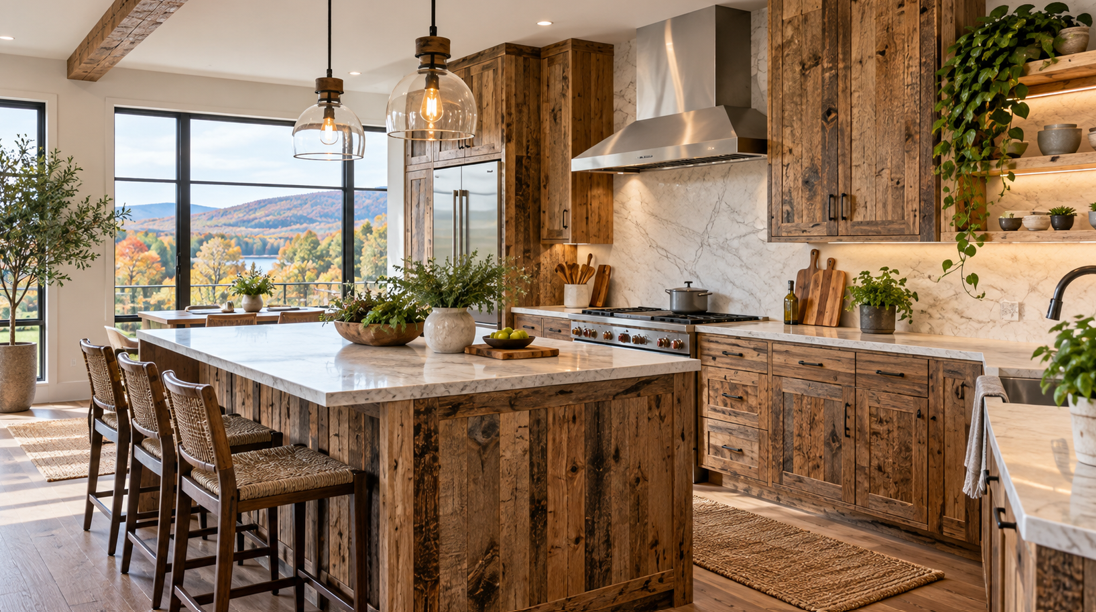
A beautiful kitchen can make a home feel renewed. Increasingly, however, homeowners are looking beyond colour, door style and hardware when choosing cabinetry. They also want to understand where their materials come from, how those materials affect the home and whether the kitchen they create will still feel relevant years from now.
That makes sustainable cabinetry especially compelling for homeowners across Orange County, NY. Natural wood, reclaimed materials, thoughtful finishes and durable construction can create a kitchen that feels warm and distinctive while supporting a more considered approach to renovation.
The timing is particularly fitting. Wood cabinetry has moved ahead of white cabinetry among renovating homeowners in the 2026 Houzz Kitchen Trends Study, while the National Kitchen & Bath Association reports growing interest in wood grain, natural materials and organic design.
At Dash Cabinetry, we believe a kitchen can be both artful and practical. For Orange County homeowners considering an environmentally conscious renovation, that means looking at the complete cabinetry picture: material sourcing, construction, finishes, longevity and the way the finished design will function every day.
What Makes Kitchen Cabinetry More Sustainable?
“Sustainable cabinets” can describe several different ideas, and understanding the distinctions makes it easier to compare options intelligently.
A cabinet does not become environmentally responsible because it has a natural-looking wood finish. The more meaningful questions involve where the wood originated, how efficiently it was used, what materials form the cabinet box, which adhesives and coatings were applied, how durable the finished product is and what happens to existing materials during renovation.
One important consideration is responsible wood sourcing. Forest Stewardship Council certification, for example, provides independent verification for wood sourced through FSC-certified supply chains. FSC describes certified sourcing as a way of supporting responsible forest management and giving buyers clearer information about the origin of wood products.
Engineered materials deserve attention as well. Plywood, MDF and particleboard are widely used throughout the cabinetry industry because they can provide stability, consistency and efficient use of wood fibre. For composite wood products sold in the United States, EPA regulations under TSCA Title VI establish formaldehyde-emission standards and certification requirements.
For homeowners, the practical lesson is that sustainability is rarely about choosing between “natural” and “manufactured”. A better approach is to examine the complete specification.
A thoughtfully selected cabinet combines responsible materials, appropriate construction, a durable finish and a design that will remain useful for many years.
That last point matters more than it may initially appear. Replacing poorly selected cabinetry after a short period consumes more materials, labour and transportation than investing in cabinetry designed to perform beautifully over the long term.
Why Reclaimed Wood Cabinets Have Such Distinctive Character
Reclaimed wood offers something newly manufactured material cannot entirely reproduce: history.
The boards may display knots, colour variation, old growth patterns, nail marks, weathering or subtle irregularities created over decades. Instead of hiding those characteristics, a skilled kitchen design can celebrate them.
For an Orange County home with farmhouse, transitional, rustic-modern or organic contemporary influences, reclaimed wood can introduce depth without making the kitchen feel artificially distressed. A reclaimed oak island surrounded by quieter perimeter cabinetry, for example, can become an architectural centrepiece. Reclaimed wood doors can add texture to a pantry wall, while selected reclaimed accents can create warmth alongside stone countertops and refined hardware.
There is an environmental argument for reuse as well. New York State’s Department of Environmental Conservation encourages the recovery and reuse of suitable building materials as an alternative to sending reusable materials into the waste stream. Its guidance specifically identifies lumber and cabinetry among materials that may sometimes be salvaged during renovation and deconstruction projects.
Reclaimed wood does require careful evaluation. Age by itself does not guarantee that a board is suitable for cabinetry. Wood intended for an interior kitchen application needs to be appropriately prepared and stable. Its moisture condition, previous coatings, structural integrity and suitability for precision fabrication all deserve professional consideration.
That is why reclaimed wood often works particularly well as a deliberate design feature rather than something added indiscriminately throughout the room. Its variations become part of the composition.
The result can feel bespoke in the truest sense: not a manufactured imitation of age, but material carrying its own individual visual history.
Responsibly Sourced New Wood Can Be an Excellent Alternative
Homeowners interested in sustainable kitchen design do not have to use reclaimed lumber to create an environmentally conscious space.
Responsibly sourced new wood can provide the warmth and authenticity homeowners want while offering greater predictability in grain, dimensions, colour matching and construction.
This is particularly relevant in 2026 because natural wood has returned strongly to kitchen design. Houzz found wood cabinetry chosen by 29% of renovating homeowners, moving ahead of white at 28%. NKBA's industry research likewise found that 59% of respondents saw wood grain increasing in popularity, with white oak leading the wood species identified in its report.
White Oak
White oak is an excellent choice for kitchens that need warmth without visual heaviness. Its grain works beautifully with contemporary slab doors as well as refined Shaker profiles, allowing it to move comfortably between modern and transitional interiors.
Lighter natural finishes can also help an Orange County kitchen feel open and calm, especially when paired with warm whites, creamy stone or softly veined quartzite.
Maple
Maple offers a smoother, more restrained grain. It is well suited to homeowners who appreciate natural wood but want a cleaner visual field. Its versatility also allows it to take a variety of finishes, making it useful for kitchens that bridge traditional architecture and contemporary detailing.
Walnut
For a richer statement, walnut delivers unmistakable depth. Its darker tones and expressive grain work particularly well on islands, tall cabinetry or selected focal areas.
Because richly figured woods have such visual presence, they often need less embellishment. Simple door profiles and restrained hardware allow the material itself to become the design feature.
When exploring kitchen cabinets, we recommend thinking beyond the initial sample. Consider how the species, cut, stain and finish will interact with flooring, countertops, daylight and the adjoining spaces of the home.
Low-Emission Materials and Finishes Matter Inside the Home
Sustainable kitchen design is not concerned exclusively with forests and material consumption. The indoor environment deserves consideration as well.
Modern cabinetry can contain a combination of solid lumber, plywood, MDF, particleboard, adhesives, coatings and finishes. That does not automatically make engineered cabinetry undesirable. High-quality engineered components can offer impressive stability and allow manufacturers to use wood resources efficiently.
What matters is knowing what is being specified.
The US Environmental Protection Agency's TSCA Title VI rules cover regulated composite wood products including hardwood plywood, MDF and particleboard. Products covered by the regulation are subject to formaldehyde-emission standards and certification requirements.
Homeowners interested in a health-conscious kitchen can therefore ask their designer about the cabinet box material, panel construction and available low-emission options rather than assuming solid wood is the single meaningful measure of quality.
Finishes are another part of the conversation. Waterborne and lower-emission coating systems are available across parts of the cabinetry market, although specifications vary significantly between manufacturers and product lines.
This is an area where personalised guidance becomes valuable. A family may prioritise indoor-air considerations, while another homeowner may place greater emphasis on scratch resistance, colour consistency or the character of a particular wood species.
A well-planned kitchen brings those priorities together rather than treating sustainability as a separate feature added at the end.
Durability May Be the Most Practical Form of Sustainability
Kitchen design moves through trends quickly. Quality cabinetry does not need to.
One of the most effective ways to make a kitchen renovation more sustainable is to design a room that will not feel disposable in five years.
That means separating elements with lasting design value from details that can be changed more easily.
Natural wood is particularly effective in this respect. Oak, maple and walnut have moved through many design periods because the material itself is timeless. What changes is the way it is presented. A heavily ornamented oak kitchen from decades ago feels very different from today's clean-lined white oak cabinetry, even though both begin with the same natural material.
For Orange County homeowners, we often recommend treating the cabinet architecture as the enduring foundation of the room. Door proportions, storage planning, cabinet construction and workflow deserve long-term thinking.
More changeable personality can then come from elements such as hardware, stools, lighting, wall colour and decorative accessories.
Durability also depends on functionality. A cabinet that looks elegant but fails to accommodate the household's storage requirements may eventually become frustrating. Thoughtful interiors — deep drawers, pantry storage, waste pull-outs, tray dividers and purpose-designed appliance storage — help cabinetry remain useful as routines evolve.
This aligns with broader 2026 renovation behaviour. Houzz reports that homeowners are placing significant emphasis on functionality and built-in storage, with pantry cabinets leading its list of built-in kitchen features.
Sustainability, in that sense, is not a particular aesthetic. It is creating a kitchen worth keeping.
Can Existing Kitchen Materials Be Reused?
Sometimes the greenest material is the material already in the home.
A kitchen renovation does not necessarily require every existing component to enter the waste stream. Depending on its condition and the scope of the project, cabinetry, hardware, stone, appliances, fixtures or lumber may have opportunities for reuse, donation, salvage or repurposing.
New York State actively promotes building-material reuse and deconstruction. The Department of Environmental Conservation notes that carefully recovering usable materials can reduce the need for newly extracted resources and divert valuable materials from disposal.
For a kitchen project, this requires planning before demolition begins.
Existing cabinets in good condition might be suitable for a garage, laundry room, basement workspace or secondary property. Hardware can sometimes be retained or donated. Solid lumber may have another purpose. Certain architectural elements from older Orange County homes can even become design features within the new space.
Not every material will be reusable, particularly when deterioration, coatings or construction methods make recovery impractical. The important distinction is considering reuse before everything is removed.
A sustainable renovation therefore starts earlier than cabinet selection. It starts with understanding what the existing kitchen contains and deciding thoughtfully what deserves another life.
How to Create an Eco-Friendly Kitchen Without Sacrificing Luxury
Sustainability and luxury are sometimes presented as opposites. In a well-designed kitchen, they can reinforce one another.
The qualities associated with exceptional cabinetry — authentic materials, meticulous detailing, intelligent storage and lasting construction — naturally support a more considered approach to consumption.
An eco-conscious Orange County kitchen can still feature a dramatic island, premium stone surfaces, beautifully integrated appliances and bespoke millwork. The difference is that every element earns its place.
Rather than adding decorative features for the sake of visual impact, consider material richness. Natural wood grain provides variation that printed decoration cannot replicate. A handcrafted reclaimed feature can become more distinctive than a mass-produced ornamental element. Precision cabinetry that hides appliances or creates uninterrupted storage walls can make the room feel calmer while improving its everyday functionality.
Colour can be equally restrained and expressive. Warm wood paired with cream, mushroom, taupe or soft green creates an organic palette. For greater contrast, walnut or reclaimed timber can sit beautifully beside pale countertops and brushed metal hardware.
The goal is not to make a kitchen look environmentally conscious.
The goal is to create something refined enough, practical enough and personal enough that replacing it prematurely never feels necessary.
Seven Questions to Ask When Choosing Sustainable Cabinets
When comparing cabinetry for an environmentally conscious renovation, these questions can make the conversation much more useful:
Where does the wood come from? Ask what information is available about species, origin and responsible sourcing or third-party certification.
What is the cabinet box made from? Understand whether the construction uses plywood, MDF, particleboard, solid lumber or a combination.
Do composite wood components comply with applicable US emissions standards? TSCA Title VI compliance is an important baseline for regulated composite wood products.
What finish is used? Ask about available coating systems, their durability and any lower-emission alternatives offered by the manufacturer.
How long is this cabinetry designed to remain serviceable? Construction quality, hinges, drawer systems and finish durability all influence useful life.
Can any materials from the existing kitchen be salvaged or reused? Planning this before removal creates more options.
Will the design still function as the household changes? Adaptable storage and timeless planning can prevent another unnecessary renovation later.
There may not be one cabinet line that delivers every sustainability attribute simultaneously. The better goal is to identify the combination that reflects your priorities and your home.
Sustainable Cabinet Design for Orange County, NY Homes
Orange County includes an unusually varied collection of homes, from historic properties and rural residences to newer developments and contemporary family homes. That variety makes highly individual cabinetry particularly valuable.
A farmhouse-inspired home may suit character-rich reclaimed wood or naturally finished oak. A newer open-plan property might call for flat-panel white oak cabinetry with integrated storage and minimal visual interruption. A transitional home can combine painted perimeter cabinets with a natural-wood island to achieve warmth without changing the entire architectural language of the space.
Local lifestyle matters as much as architecture. Generous kitchens frequently serve as gathering spaces for extended family and guests, making storage, durability and circulation essential parts of the design.
That is where professional planning can transform an environmentally conscious idea into a kitchen that genuinely works.
Through material selection, detailed space planning and realistic 3D renditions, homeowners can evaluate the entire composition before installation begins — cabinetry, countertops, finishes and functionality together.
Create a Kitchen Designed to Last
Eco-friendly cabinetry does not require compromising the beauty of your kitchen. In many cases, thinking more carefully about materials leads to a more sophisticated result.
Reclaimed timber can bring history and individuality. Responsibly sourced natural wood can add enduring warmth. Thoughtfully selected composite materials and finishes can support performance and indoor-air priorities. Intelligent storage and precision installation can extend the useful life of the entire kitchen.
Most importantly, sustainable design encourages homeowners to move beyond fleeting trends and create a space they will continue to value.
For Orange County, NY homeowners planning a kitchen renovation, Dash Cabinetry offers a personalised approach to cabinetry, material selection, 3D design and professional installation from our Monsey showroom. We can help you compare wood species, cabinet construction, finishes and design possibilities while balancing sustainability with the level of refinement your home deserves.
Ready to explore the possibilities? Schedule a consultation and begin creating a kitchen where thoughtful materials, exceptional function and enduring design come together.

